
Distressed Real Estate Recap: Legal, Business, and Tax Strategies for a Challenging Market
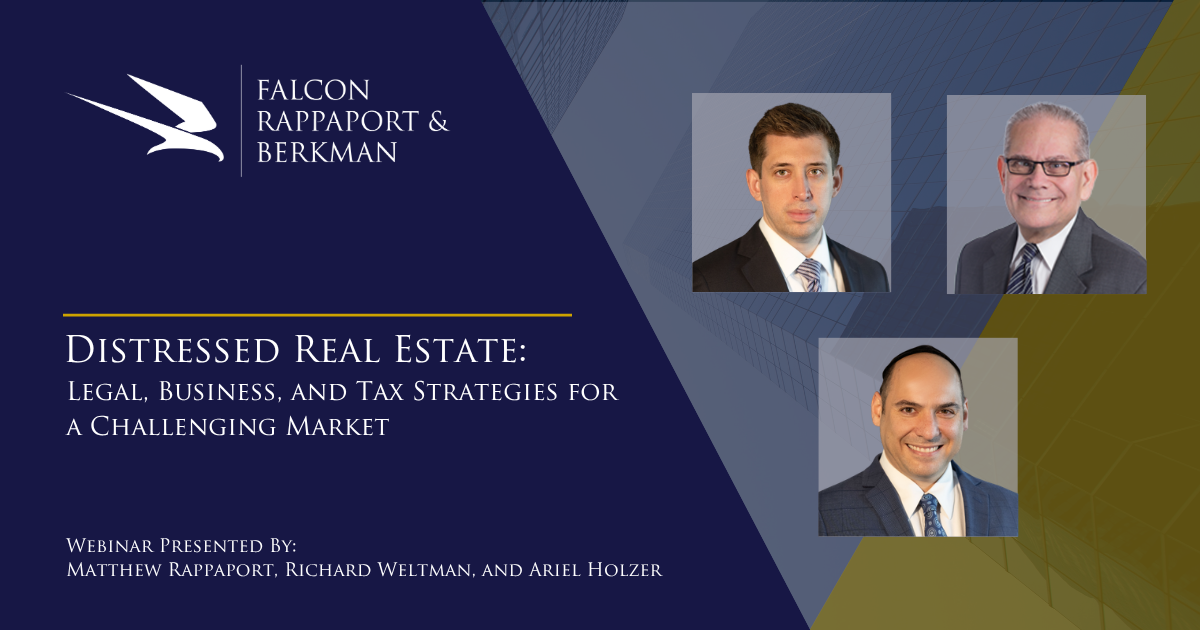
Commercial real estate is under pressure. Rising interest rates, falling property values, and sector-specific weakness have left owners, lenders, and investors facing hard choices. In our recent webinar, three of our attorneys from different practice groups came together to break down what happens when a deal goes sideways, and what the key players, can do about it. The panel featured FRB Vice Managing Partner Matthew Rappaport, Creditors’ Rights & Bankruptcy Partner Richard Weltman, and Real Estate Partner and Co-Chair Ariel Holzer.
Why Now?
Much of today’s distress traces back to the zero-interest-rate environment of the COVID years. Borrowers who took on variable-rate financing, or loans with rates set to reset after an initial period, are now facing sharply higher costs as central banks have raised rates. Add to that sector-specific weakness (office and certain retail properties haven't recovered evenly across markets), declining property values that leave some loans "underwater," and all the ingredients for widespread distress are present.
What Makes a Property "Distressed"?
Ariel Holzer laid out the practical markers lenders watch for: a debt service coverage ratio (DSCR) that drops below the loan covenant (often 1.2–1.5, and certainly below 1.0), maturity walls where a loan can't be refinanced at today's higher rates, non-monetary defaults (missed insurance, blown reporting deadlines, unauthorized transfers), falling occupancy, and deferred maintenance that owners can no longer afford to address. In rent-regulated markets like New York City, rising construction and labor costs paired with frozen rents are squeezing owners particularly hard.
The Four Players and Their Competing Interests
A recurring theme was that every distressed deal involves stakeholders pulling in different directions:
- Owners want to preserve the asset and avoid enforcement.
- Lenders generally don't want to own real estate and often prefer a workout over foreclosure.
- Investors may pursue loan-to-own strategies, buying discounted debt specifically to gain control of the property.
- Guarantors are focused on avoiding personal liability, including "bad boy" carve-outs that can convert non-recourse debt into recourse debt.
Receivership got special attention as a tool that can arise not just from financial distress but from ownership disputes. Sometimes partners simply can't agree, and a neutral court-appointed receiver becomes the least-bad option for everyone.
The Workout Toolkit
Richard Weltman walked through the menu of options lenders and borrowers use before things escalate: maturity extensions, rate modifications, forbearance, partial paydowns, and (rarely with institutional lenders but more common with private capital) equity kickers. He cautioned that any modification triggers its own risks, including potential cancellation-of-debt (COD) tax liability and re-recording obligations.
CMBS loans came in for particular scrutiny. Because these loans are pooled and sold to investors, special servicers have little flexibility to deviate from the documents, even when a different outcome would clearly recover more money, because doing so exposes them to securities litigation risk.
Foreclosure, Deeds in Lieu, and Bankruptcy
Ariel and Richard covered the mechanics of enforcement: judicial foreclosure (slow, common in states like New York) versus non-judicial foreclosure (faster, available in many southeastern and western states); deeds in lieu as a quicker alternative that still requires careful negotiation over junior liens and release of liability; and bankruptcy's Section 363 sales, which allow assets to be sold free and clear of liens under court supervision, often paired with "stalking horse" bidding to establish a price floor.
Tax Consequences Are Everywhere
Matthew Rappaport closed with a tour of the tax traps hiding inside every workout: cancellation-of-debt income under Section 108, original issue discount issues in debt-for-debt exchanges, and partnership-level wrinkles under Section 752 where bringing in a new investor to rescue a deal can inadvertently trigger deemed distributions and unexpected gain for existing partners.
The Takeaway
Distress creates both risk and opportunity, but only for those who act early and coordinate across disciplines. A deal that looks fully negotiated between borrower and lender can fall apart entirely once tax consequences are factored in. Legal, real estate, and tax counsel need to be at the table from day one, not brought in after the fact. If you're navigating a distressed real estate situation, our team of attorneys is ready to help.
Check out the full webinar recording and the presentation materials, or contact us to learn how our attorneys can help you navigate loan workouts, foreclosure, bankruptcy, or the tax implications of a distressed real estate matter.
DISCLAIMER: This summary is not legal advice and does not create any attorney-client relationship. This summary does not provide a definitive legal opinion for any factual situation. Before the firm can provide legal advice or opinion to any person or entity, the specific facts at issue must be reviewed by the firm. Before an attorney-client relationship is formed, the firm must have a signed engagement letter with a client setting forth the Firm’s scope and terms of representation. The information contained herein is based upon the law at the time of publication.