
Deep Bench Briefings Recap: Mine, Yours, or the Machine’s? The New Rules of IP Ownership in the Age of AI
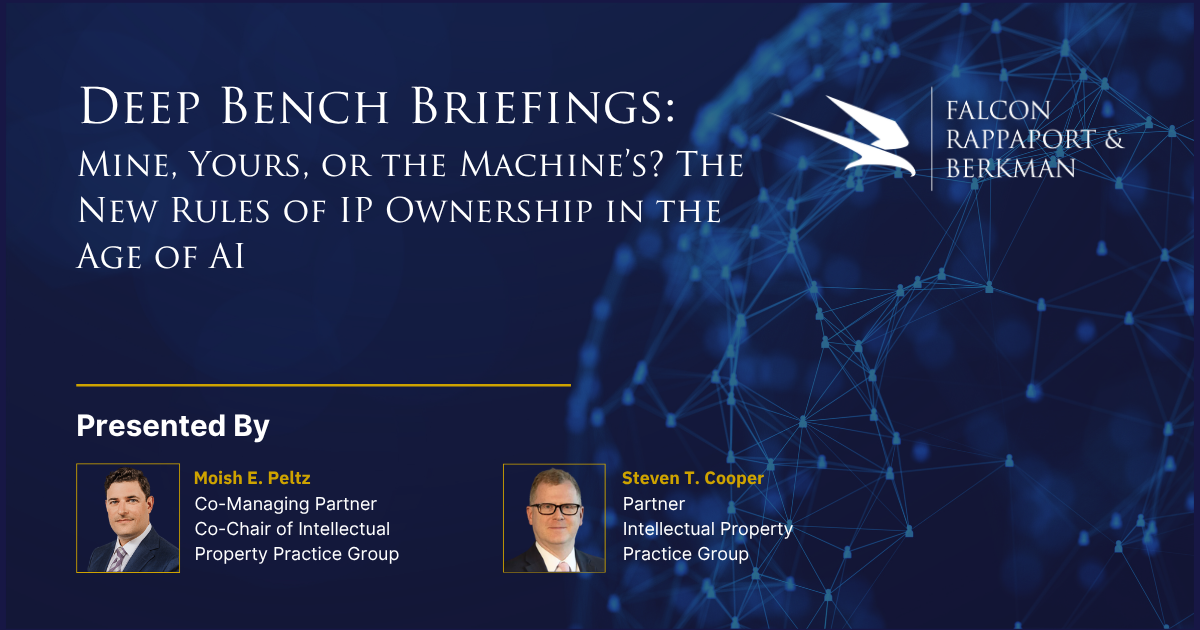
For business owners, founders, and in-house teams building products, brands, and technology, intellectual property is often the most valuable thing on the balance sheet, and the easiest thing to lose control of when the paperwork doesn't match reality. In the latest installment of the Deep Bench Briefings series, FRB Co-Managing Partner and Intellectual Property Practice Group Chair Moish Peltz was joined by Intellectual Property Partner Steven Cooper to unpack a question that AI has made both more urgent and more complicated: who actually owns what your business creates?
The throughline of the discussion: AI hasn't rewritten intellectual property law, but it has made the consequences of sloppy ownership practices far more expensive, and the window for fixing mistakes far smaller.
Check out the full recording:
Ownership Decides Everything
The session opened with a foundational point that runs through every area of IP: if you don't clearly own it, you can't protect it, license it, sell it, or enforce it.
As our attorneys explained, ownership questions rarely surface at convenient moments. They come up during financing rounds, M&A due diligence, or litigation, precisely the situations where uncertainty translates directly into lost value. A buyer who can't confirm clean title of a patent portfolio will discount the purchase price. A company that discovers its trademark is registered under the wrong entity may find the registration void on its face. A founder who never obtained a written assignment from the contractor who built the company's core software may not be able to enforce rights against a competitor at all.
Our presenters emphasized that recording ownership correctly at the outset is typically a simple and inexpensive process. It's the corrections that get costly: tracking down former employees to sign assignments, untangling registrations split across the wrong entities, or discovering mid-transaction that a chain of title has gaps. The safest assumption for any business: unless you have a document in writing, you don't own it.
The Four Types of IP (and How AI Changes Each One)
Copyright
Copyright protects creative works fixed in a tangible medium (written text, photographs, video, artwork, and computer software). The default rule: the author owns it. For employees acting within the scope of their employment, a "work made for hire" can vest ownership in the company, but the presenters cautioned that this is a narrower legal concept than most people assume. For independent contractors, work-made-for-hire applies only in limited statutory categories, meaning businesses should go into every contractor engagement assuming they need a written assignment.
Where AI complicates things: U.S. copyright law has always required human authorship, and AI cannot be the sole author of a copyrightable work. The presenters described this as a sliding scale, using AI as an assistive tool (editing a photograph, refining a draft) likely preserves copyright protection, while prompting AI to generate a work from whole cloth likely does not. The exact boundaries remain untested, and the presenters noted there is significant ambiguity in the middle of that spectrum, particularly around detailed prompting. The practical takeaway: the more AI is involved in the creation, the less likely the output is to be protectable.
Patents
Patent ownership follows a similar logic: the inventor, the natural person who conceived of the invention, owns the patent rights at the outset. There is no work-for-hire analog in patent law, so companies must secure written assignments from employee and contractor inventors, both prospectively (in employment or engagement agreements) and contemporaneously (for each specific invention). Assignments should be recorded with the USPTO to establish a clean, publicly available chain of title.
AI cannot be named as an inventor on a U.S. patent application, and if AI is the one that actually conceived of the claimed invention, the resulting patent may face questions of validity. The presenters drew a clear line between using AI as a tool in the inventive process (running simulations, refining data, assisting with analysis) and having AI generate the core inventive concept itself. Even in countries that may permit AI inventors, that won't satisfy U.S. filing requirements.
The presenters also flagged a risk unique to patents: inputting details about a potential invention into an open or consumer-grade AI model can constitute a public disclosure, which can destroy patent rights, particularly in countries with no grace period. This makes enterprise-grade AI tools and robust usage policies not just a governance preference but a condition of maintaining patentability.
Trademarks
Trademarks offered a welcome contrast. Because trademark rights are based on use, who is actually using the mark in commerce as a source identifier for goods or services, the method of creation matters less than it does for copyright or patents. A company that uses an AI-generated logo as its brand identifier still owns the trademark rights in that logo.
But the presenters warned against stopping the analysis there. A logo is also a copyrightable work, and if a designer used AI to generate it from whole cloth rather than creating it with meaningful human input, the logo may not be protectable under copyright, even if the trademark rights are secure. Businesses should ensure that any branding assets created with AI involvement are produced in a way that preserves both trademark and copyright protection.
Trade Secrets
Trade secrets (formulas, customer data, processes, pricing structures, and proprietary models) drew the most nuanced discussion of the session. Unlike the other categories, trade secret protection springs not from registration but from maintaining reasonable secrecy measures: NDAs, technical access controls, internal privacy policies, and onboarding and offboarding protocols. The applicable frameworks are the federal Defend Trade Secrets Act (DTSA) and state-level Uniform Trade Secrets Acts.
AI introduces two distinct risks. The first is leakage: employees, contractors, or vendors who input confidential information into consumer AI tools that train on user data can destroy trade secret status in a single prompt. If the information is no longer secret, there is no protection — full stop. The presenters stressed the importance of reviewing vendor terms, understanding data retention policies, and ensuring that AI governance policies explicitly address how proprietary information may and may not be used with AI tools.
The second risk is more structural. Reverse engineering and independent discovery have always been complete defenses to trade secret claims. AI now makes both dramatically easier. As the presenters put it, AI can brute-force its way around a company's secret sauce, spending millions of tokens working through possibilities until it arrives at the answer. This doesn't change the law, but it changes the practical calculus. A trade secret that could once be maintained indefinitely may now be vulnerable to independent recreation by a competitor's AI in a fraction of the time.
This shift also has strategic implications for the patent-versus-trade-secret decision. Patent protection offers limited monopoly but requires public disclosure of the invention. Trade secret protection lasts indefinitely but only as long as secrecy holds. If AI makes reverse engineering trivial, the indefinite duration of trade secret protection becomes less valuable, and the enforceable exclusivity of a patent may look more attractive, even with its disclosure requirement and eventual.
Documenting Ownership: The Internal and External Agreement Stack
The presenters walked through the documentation framework that businesses should have in place to secure IP ownership across the organization.
Internal agreements such as employment and contractor agreements should include clear, written IP assignment provisions before any work begins. For employees, this means language that assigns all IP created within the scope of employment, with both a prospective obligation and a confirmatory assignment executed for each specific asset. For contractors, the same principle applies with added urgency: contractors are more likely to retain ownership by default, and tracking down a former contractor years later to sign an assignment is both expensive and uncertain.
Critically, the presenters noted that any employment or contractor agreement that hasn't been updated in the last several years almost certainly does not address AI (how the worker may use AI tools, what happens to IP created with AI assistance, and what safeguards apply to proprietary information used in AI workflows). Updating these agreements is not optional.
External agreements should address who owns the outputs of any joint project or business relationship, including outputs generated with AI tools. The presenters described a dispute involving a manufacturer and distributor who spent a decade building a product together without ever documenting who owned the trademark — a problem that could have been resolved in a single paragraph at the outset. Whether it's a joint venture, a vendor relationship, or a co-development arrangement, ownership of IP created during the engagement should be spelled out before work begins.
Filings — patent, trademark, and copyright registrations — round out the documentation stack. Registrations create presumptions of validity and establish a public record of ownership. The presenters noted that IP offices generally won't investigate ownership claims at the time of filing; they accept the applicant's sworn declaration. Challenges come years later, during enforcement or transactions, which is precisely when a business needs to be able to prove not just that it filed for protection but that it legitimately owned the IP at every step.
Key Takeaways
Across the hour, the presenters returned to a consistent set of principles:
- Ownership decides everything. You cannot protect, license, sell, or enforce IP you don't clearly own, and ownership gaps almost always surface at the worst possible time.
- AI hasn't changed IP law, but it has raised the stakes. The same rules around human authorship, inventorship, and ownership apply, but AI makes it easier to inadvertently create assets that fall outside those protections.
- "We paid for it, so we own it" is not how it works. In nearly every category of IP, a written agreement is required to transfer ownership from the creator to the business. Paying for the work is not enough.
- Copyright and patents both require human contribution. AI cannot be a sole author or inventor. The more AI is involved in the creative or inventive process, the greater the risk that the output is unprotectable.
- Trade secrets face a new threat from AI-powered reverse engineering. Independent discovery and reverse engineering are complete legal defenses, and AI makes both faster and cheaper, potentially shifting the strategic calculus toward patent protection for certain assets.
- Leakage is the most immediate AI risk for trade secrets. Employees or vendors who input confidential information into consumer AI tools can destroy trade secret status entirely.
- Contractor agreements are a major gap. If your contractor agreements haven't been updated to address AI use, IP assignment, and data handling, they almost certainly don't reflect current risks.
- Document everything. Keep records of human contributions to crown-jewel assets, maintain clean chains of title, and ensure registrations are filed under the correct entity, because ownership will be challenged years after creation, not at the time of filing.
If your organization is evaluating its IP ownership practices, updating employment and contractor agreements to address AI, or preparing for a transaction or enforcement action where clean title matters, FRB's Intellectual Property Practice Group is ready to help. Contact us here or fill out the form below.