
Deep Bench Briefings Recap: Defusing Contract Landmines Before They Blow Up Your Deal
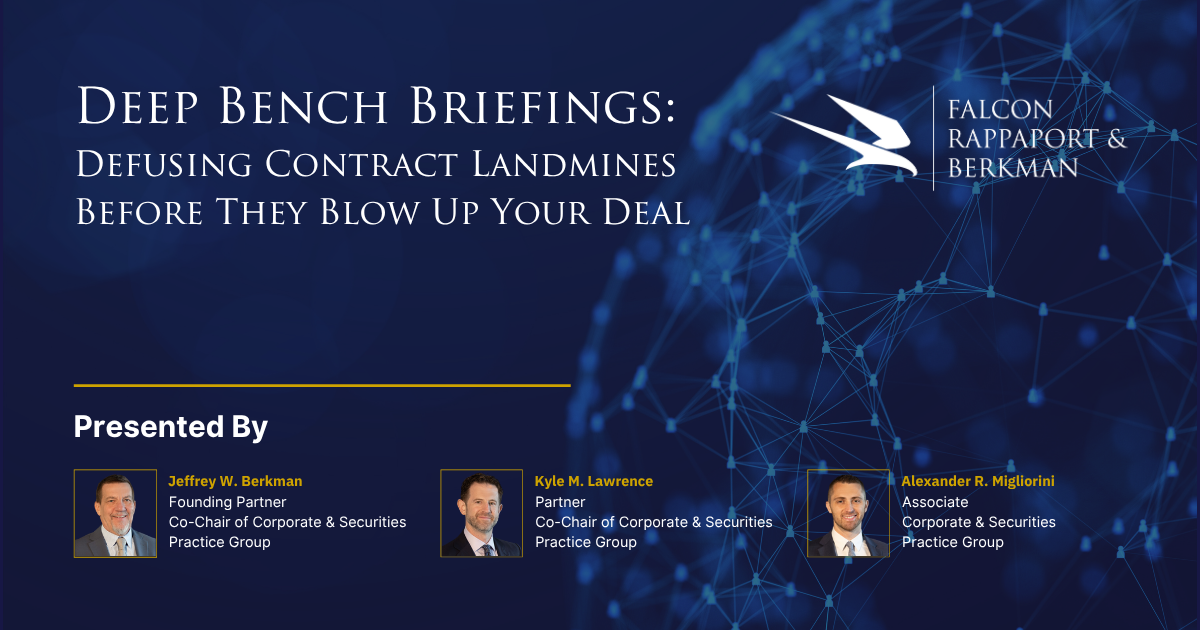
For executives, in-house counsel, and dealmakers, a contract is more than a formality to sign and file away, it's the document that will be read word-for-word the moment something goes wrong. In the latest installment of the Deep Bench Briefings series, FRB Partners Kyle M. Lawrence and Jeffrey W. Berkman, Co-Chairs of the Corporate & Securities Practice Group, were joined by Corporate Associate Alexander R. Migliorini to walk through the clauses that quietly cause the most expensive problems in business agreements, and the small drafting choices that separate an enforceable contract from a costly dispute.
The throughline of the discussion: there is no such thing as harmless “boilerplate.” Every clause, no matter how routine it looks, carries legal weight and
There Is No Boilerplate
The session opened by dismantling a common assumption: that certain contract language is generic, interchangeable, and safe to leave untouched from one deal to the next.
As our attorneys explained, courts routinely enforce boilerplate provisions exactly as written, whether or not the language actually reflects what the parties intended. Terms borrowed from a prior deal, a template, or a competitor's agreement don't lose their force just because nobody meant to include them. If a template says the governing law is Florida and the business is based in New York, that's what a court will apply, unless someone reads the document and fixes it before signing.
Our speakers noted that “standard” clauses appear across most commercial agreements — such as master service agreements, consulting agreements, operating and shareholder agreements, purchase agreements, and loan documents — precisely because certain issues arise again and again: preamble and recitals, scope of services, payment terms, indemnification, confidentiality, non-solicitation, term and termination, representations and warranties, data privacy, limitations of liability, and exclusivity. Familiarity with these categories is not the same as understanding what a specific clause says in a specific deal.
One newer addition to that list: AI consent. As AI tools become embedded in everyday business operations, agreements increasingly need to address whether a counterparty may use AI when performing services, whether that use requires enterprise-grade tools rather than free consumer accounts, and what protections apply if proprietary information ends up training a third-party model.
The Contract Landmines That Blow Up Deals
The presenters walked through several drafting patterns that look harmless but create outsized risk:
- The costly comma. Missing or misplaced punctuation can flip the meaning of a clause entirely — whether a modifier like “organic” applies to one item in a list or all of them. The presenters pointed to the Oakhurst Dairy dispute, in which a missing Oxford comma in a Maine overtime statute left the law's meaning genuinely ambiguous and ultimately cost the company a multimillion-dollar settlement.
- Shall vs. may. These two words are not interchangeable, and treating them as stylistic choices is a mistake. “Shall” creates an obligation; “may” creates an option. The presenters described a real dispute in which a reconciliation clause said a buyer “may” deliver a statement of its calculation to the seller — and the buyer used that discretion to simply skip the step and exercise an offset right instead, with no contractual obligation to explain itself.
- Vague termination triggers. A right to terminate “upon material breach” sounds reasonable, but reasonable people can disagree on what counts as material. The safer approach specifies concrete trigger events — non-payment after a defined notice period, insolvency, or failure to cure a described breach within a set number of days — so that a termination decision doesn't become its own separate dispute.
- Uncapped or ambiguous liability. A liability cap that says a party's exposure “shall not exceed fees paid” sounds protective, but the word “any” can leave open whether the cap applies per claim or in the aggregate. Precise caps specify what the limitation covers, over what time period, and whether it applies across contract, tort, or other claims.
Where Nebulous Drafting Meets the Courtroom
Court decisions were used throughout the session to reinforce a single principle: judges generally will not rewrite a poorly drafted contract to reflect what the parties probably meant.
Under the parol evidence rule, courts largely stay within the four corners of a signed agreement when its language is clear, particularly between sophisticated parties. In one example the presenters described, a party who obtained an oral agreement to extend a deadline still lost the argument in court because the contract's notice provision required any extension to be in writing — the oral agreement, however genuine, didn't satisfy the clause as drafted.
The takeaway: ambiguity gets litigated, not resolved by judicial goodwill. If precise language wasn't in the document at signing, courts are unlikely to supply it later.
Indemnification: Where Vagueness Gets the Most Expensive
Indemnification drew particular focus, and for good reason — it's often the most heavily negotiated section of an agreement and the one where unclear drafting, or a lack of clarity with respect to a specific understanding of a client’s business, often causes the most financial damage.
The presenters distinguished between “agrees to indemnify” language, which leaves substantive gaps, and stronger formulations that require a party to defend, indemnify, and hold the other party harmless against third-party claims arising out of or relating to the agreement. Each of those obligations — defense, indemnification, and being held harmless — carries a distinct legal meaning and should be addressed deliberately rather than assumed to be interchangeable.
Key elements an effective indemnification clause should nail down include:
- Scope: whether coverage extends only to third-party claims, or also to specific concerns like intellectual property infringement, data security incidents, or privacy violations — categories the presenters emphasized should rarely be subject to a liability cap given the scale of exposure they can create.
- Carve-outs: excluding indemnification protection for a party's own gross negligence or willful misconduct.
- Caps and baskets: setting aggregate limits, fixed-dollar caps, or deductible-style thresholds, while considering whether certain breaches (confidentiality, privacy, non-solicitation) warrant a higher or uncapped exposure given how much damage they can cause.
- Notice requirements: specifying whether a delay in notifying the other party of a claim bars recovery entirely, or only reduces recovery to the extent the delay caused additional harm.
- Survival periods: defining how long representations and warranties — and the indemnification obligations tied to them — remain enforceable after closing, so that stale claims don't resurface years after a deal closes.
NDAs: Drafting Traps in the Most Common Deal Document
Non-disclosure agreements may be the most frequently signed documents in business, and, according to the presenters, also among the most under-drafted. Many organizations treat them as nothing more than a formality — swap out the party names and move on — without tailoring the substance to the actual relationship.
The presenters recommended treating a handful of provisions as anything but routine:
- Definition of confidential information should be tailored to the industry and relationship — customer lists and sales data for a sales organization, source code for a tech company, formulas and recipes for a food and beverage business — rather than a generic catch-all. A definition copied from an unrelated prior deal can create ambiguity, or worse, tip off a client that the agreement wasn't actually reviewed.
- Purpose-specific protections matter, particularly in M&A contexts, where confidentiality terms should also prevent a party from using information learned in discussions to gain leverage against other potential counterparties.
- No warranty language protects a disclosing party by making clear that information shared during early-stage discussions is provided “as is,” without any right of reliance — reducing exposure if preliminary financials or other materials later turn out to be inaccurate.
- Injunctive relief clauses should give a disclosing party the right to seek injunctive relief, not assert an automatic entitlement to it — courts, not contracts, ultimately decide whether an injunction is warranted.
- AI and data handling provisions should address whether a counterparty may input shared information into AI tools, and if so, under what safeguards — since entering non-public information into a personal or free-tier AI account can itself create a confidentiality breach and downstream liability.
Key Takeaways
Across the hour, a handful of principles came up repeatedly:
- There is no such thing as harmless boilerplate — every clause should be tailored to the actual transaction, and “that's what the template said” is not a defense.
- Precision prevents litigation. Choice of law, forum selection, force majeure, notice, and termination clauses all require deliberate, specific language.
- Indemnification is where vague drafting gets the most expensive — scope, triggers, caps, carve-outs, notice requirements, and survival periods all need to be spelled out.
- Courts will not rewrite an ambiguous contract on a party's behalf. Ambiguity gets litigated, not resolved in a party's favor out of fairness.
- NDAs deserve real attention, not a copy-paste treatment — the definition of confidential information and the scope of protection should match the actual relationship and information at stake.
- AI use is becoming a standard contract issue, not an edge case — agreements should address consent, enterprise-grade tools, and safeguards around confidential and proprietary information.
- The cost of precision is always lower than the cost of litigation.
If your organization is negotiating a master service agreement, drafting or reviewing an NDA, or looking for a second set of eyes on indemnification and liability provisions before a deal closes, FRB's Corporate & Securities Practice Group is ready to help. Contact us here or fill out the form below.
DISCLAIMER: This summary is not legal advice and does not create any attorney-client relationship. This summary does not provide a definitive legal opinion for any factual situation. Before the firm can provide legal advice or opinion to any person or entity, the specific facts at issue must be reviewed by the firm. Before an attorney-client relationship is formed, the firm must have a signed engagement letter with a client setting forth the Firm’s scope and terms of representation. The information contained herein is based upon the law at the time of publication.