
Deep Bench Briefings Recap: But ChatGPT Said I Was Right: Responding to Workplace Complaints in the Age of AI
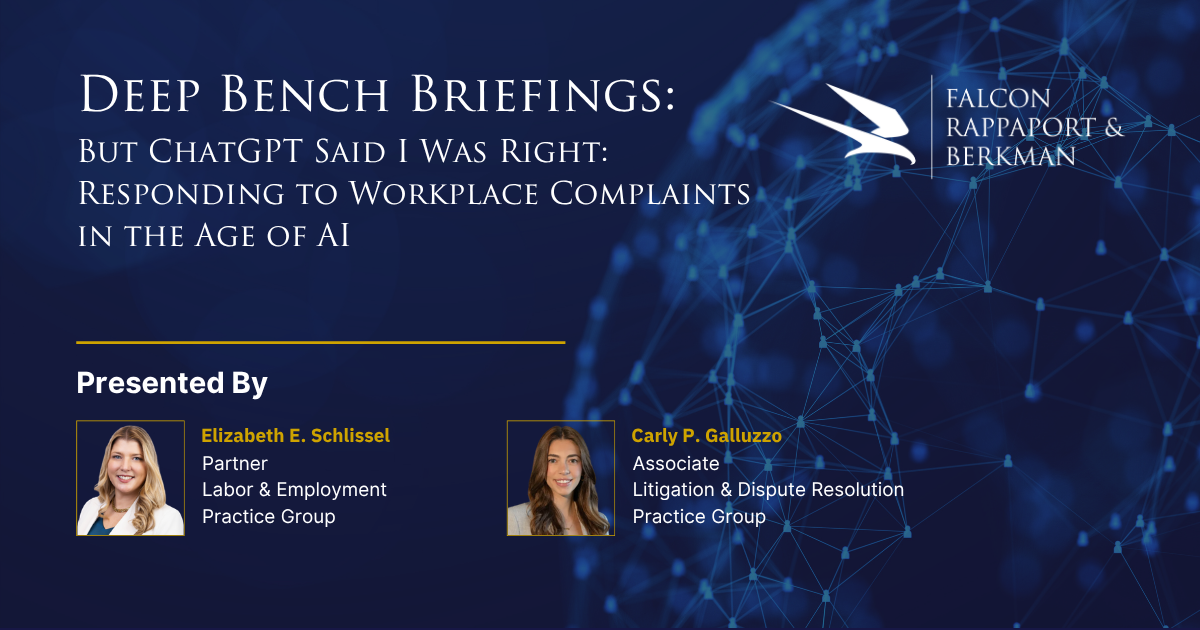
For HR directors, in-house counsel, and managers who handle workplace complaints, the format of those complaints has changed dramatically over the past year and a half, even though the underlying facts often haven’t. In the latest installment of the Deep Bench Briefings series, FRB Labor & Employment Practice Group Chair Elizabeth Schlissel was joined by Litigation & Dispute Resolution attorney Carly Galluzzo to walk through what happens when every employee has instant access to an AI tool that will confidently draft, cite, and escalate a complaint on their behalf.
The premise of the session: AI hasn’t created new categories of workplace claims, but it has changed how complaints arrive on a manager’s desk, and how quickly a minor grievance can be dressed up to look like serious litigation risk. Our speakers walked through what these AI-assisted complaints look like in practice and how managers should be trained to respond.
Check out the full recording below.
Why AI-Generated Complaints Sound So Serious
The session opened with a simple but important observation: AI chatbots rarely admit uncertainty. When a model doesn’t know something, it tends to fill the gap with a confident guess rather than a caveat. Combine that with AI’s tendency to pull unverified information from across the internet, and an authoritative, lawyerly tone that sounds credible even when it’s wrong, and you get a recipe for complaints that read like formal legal notices regardless of how serious the underlying issue actually is.
Our presenters shared examples of AI tools confidently generating incorrect information, from misidentifying historical facts to citing employment statutes that don’t exist. The point wasn’t that AI is always wrong, but that a complaint packed with legal terminology and citations can look identical whether the underlying claim is strong or completely unfounded.
Their recommended fix is simple: when a lengthy, statute-laden complaint lands in your inbox, mentally strip out every legal label and reread what’s left. If the remaining facts amount to “my boss was short with me in a meeting,” that’s a management issue. If they amount to “my boss said he doesn’t promote people over fifty,” that’s a legal one. Labels are noise. Facts drive the actual claim.
The AI-Educated Employee
The speakers illustrated a recurring pattern: an employee has a real but minor complaint, feeds it into a chatbot, and receives back a polished document loaded with legal terminology and citations. The danger isn’t the complaint itself. It’s how managers respond to it.
Liz and Carly were emphatic on this point: never argue the legal standard with an employee. When a supervisor pushes back by insisting something “isn’t legally a hostile work environment,” they accomplish two things, neither of which helps the company. First, they hand the employee the exact legal framework needed to revise the complaint until it fits. Second, they turn a morale issue into a potential retaliation claim. The better approach, demonstrated by the group’s “voice of reason” character, is to listen, gather facts, and address the real issue rather than the formatting.
Our presenters also cautioned that “trigger words” like hostile work environment, discrimination, retaliation, and reasonable accommodation are increasingly showing up in complaints where employees may not fully understand the legal elements behind them. The goal for managers should be to look past the legalese to what actually happened.
Accommodation Requests, and the Cost of Doing Nothing
Liz and Carly walked through disability, religious, and pregnancy-related accommodation scenarios, each highlighting a different failure mode. In one example, an employee submits a “kitchen sink” request citing multiple statutes and asking for several accommodations, when only one is actually needed. The correct response isn’t to reject the entire request because it looks excessive. It’s to engage, ask about limitations, and identify what will actually let the employee do their job.
In another example, a manager simply never follows up on a religious accommodation request. Our presenters flagged this as a critical and common mistake: delay can function as a denial, and failing to respond at all is often more dangerous than responding incorrectly. They also noted that the legal standard for religious accommodations has shifted; employers must now show a substantial increased cost tied to the actual conduct of the business, and general references to a “busy week” or an “inconvenience” won’t meet that bar.
A pregnancy-related example drove home a related point: accommodating an employee is not the same as deciding, on her behalf, what she can and cannot do. Removing an employee from her role “for her own good,” or quietly excluding her from a business opportunity based on assumptions about her preferences, isn’t generosity. It’s an adverse action, and the same risk applies to age-based assumptions about who should be invited to a conference or given an opportunity.
Harassment, Notice, and Retaliation
Our speakers distinguished between three categories that often get collapsed into one: bad management, offensive conduct, and unlawful harassment tied to a protected characteristic. A supervisor who yells at everyone equally has a management problem, not automatically a legal one, but the moment that conduct narrows toward a protected group, the analysis changes.
They also stressed that once a company is on notice of harassment, whether through a formal complaint or an offhand comment to a manager, the duty to investigate is not optional. Minimizing a complaint, questioning whether the employee is “reading into it,” or pointing to a long history of unaddressed conduct doesn’t provide cover. It makes things worse.
On retaliation, they offered a useful frame: an employee’s underlying discrimination claim can be weak and well-documented as unfounded, but if a manager visibly punishes the employee for raising it, the company can end up with a strong, well-documented retaliation claim regardless of how the original complaint would have fared. They also noted, from direct litigation experience, that most employees decide to escalate a complaint not because of the original incident, but because of how the company responded to it. Training managers to simply say “thank you for bringing this to my attention, we will look into it,” and then actually following through, remains one of the most effective ways to prevent escalation.
The Human Element AI Can’t Replace
One theme tied the session together: many complaints that arrive dressed up in legal language are really about something simple, like feeling unappreciated or overwhelmed. The presenters warned against what they called “responding to AI with AI,” where a manager runs the complaint back through a chatbot and fires off point-by-point rebuttals. That approach can technically address every line of a complaint without resolving anything. A short, in-person conversation often surfaces the real issue and resolves it far faster than an email chain ever could.
Recording, Transcription, and Shadow AI
The session closed on privacy and documentation risk. Liz and Carly reminded attendees that recording laws vary significantly by state, from one-party consent states like New York to two-party consent states like California, but the more practical reality is that employees are recording and transcribing conversations constantly, regardless of what the law technically requires. AI notetakers and meeting assistants that transcribe, analyze tone, and flag inconsistencies create business records that are discoverable in litigation, and those transcripts are frequently inaccurate because no one goes back to correct them.
They also flagged the growing risk of “shadow AI,” where employees bypass secure, enterprise-grade AI tools in favor of personal accounts, often putting confidential or privileged information into platforms with no confidentiality protections at all. Anything typed into an open AI tool should be treated as fully discoverable. As the presenters put it, never write or paste anything into a chatbot that you wouldn’t want read back to you in a deposition.
Key Takeaways
Across the hour, our attorneys returned to a few consistent points:
- AI hasn’t created new legal claims, but it has changed how complaints look and how quickly they escalate. Facts, not formatting, should drive the response.
- Never argue the legal standard with an employee. Listen and gather facts instead.
- Delay can function as a denial. Accommodation requests need a timely, documented response.
- Accommodating an employee is not the same as deciding for them what they can or cannot do.
- Once a company is on notice of harassment, the duty to investigate is not discretionary.
- How a company responds to a complaint often matters more than the underlying complaint itself in determining whether an employee escalates further.
- AI meeting assistants and transcription tools create discoverable business records, and those records are frequently inaccurate.
- Shadow AI, employees using personal AI accounts for work matters, is a growing confidentiality and privilege risk. Treat anything typed into an open AI tool as discoverable.
If your organization is updating workplace complaint procedures, training managers on how to respond to AI-assisted complaints, or reviewing policies on AI use and recording in the workplace, FRB’s Labor & Employment Practice Group is ready to help. Contact us here or fill out the form below.