
Register for the Advanced Tax Strategy Series with Matthew Foreman
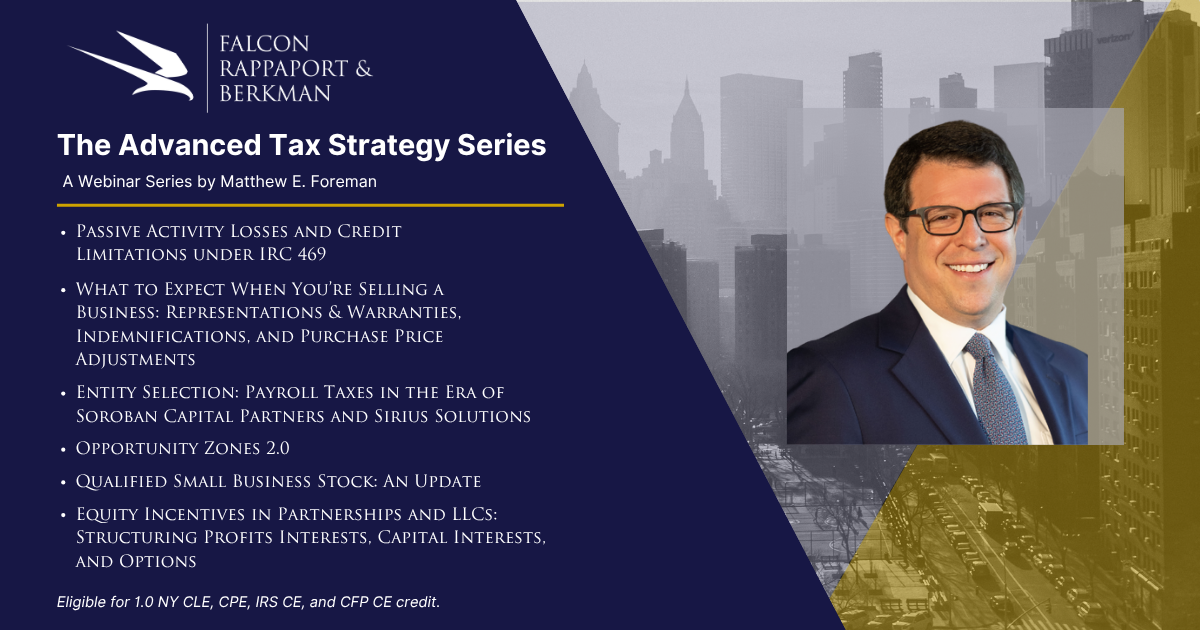
Join FRB’s Matthew Foreman, Co-Chair of the Taxation Practice Group, for a six-part webinar series The Advanced Tax Strategy Series.

Eligible for 1.0 NY CLE, CPE, IRS CE, and CFP CE credit. Learn more and register below:
Tuesday, November 3 | 1:00pm – 2:00pm ET
Passive Activity Losses and Credit Limitations under IRC 469
-
One of the most misunderstood concepts in tax law, this webinar will discuss how the passive activity limitation works, how it applies to real estate, and how to make grouping elections to maximize the benefit. Matthew Foreman will cover the history and legislative intent of the passive activity rules, define the various technical terms, and explain the limitations that prevent taxpayers from circumventing the passive activity rules.
Tuesday, November 10 | 1:00pm – 2:00pm ET
What to Expect When You’re Selling a Business: Representations & Warranties, Indemnifications, and Purchase Price Adjustments
-
Join Matthew Foreman and Kyle Lawrence to learn what to expect from tax and non-tax perspectives when you’re selling a business, including discussions of structure, representations and warranties, indemnifications, and the maximizing your after-tax proceeds. This program will provide practitioners with a discussion of common issues that arise in the sale of businesses.
Tuesday, November 17 | 1:00pm – 2:00pm ET
Entity Selection: Payroll Taxes in the Era of Soroban Capital Partners and Sirius Solutions
-
Matthew Foreman discusses Soroban Capital Partners LP v. Comm’r and Sirius Solutions LLLP v Comm’r, which deal with the imposition of self-employment taxes, focusing on the ongoing tax saga of a hedge fund partners trying to convince the IRS that they are “limited partners, as such”. This will (hopefully) include the results from the en banc Second Circuit hearing for Soroban, and is for anyone who is starting, operating, structuring, or wondering about how income tax structuring interplays with other kinds of taxes.
Tuesday, December 1 | 1:00pm – 2:00pm ET
Opportunity Zones 2.0
-
Matthew Foreman and Louis Kesselbrenner explore Opportunity Zones (OZs), including the updates from OBBBA and the regulations and guidance that are expected to be provided by the Treasury Department and the IRS. The webinar will discuss the history of Opportunity Zones, how the incentive became law, tax benefits, how OZs and qualified opportunity funds (QOFs) work, and how the incentive works (or doesn’t exist) at the state level.
Tuesday, December 8 | 1:00pm – 2:00pm ET
Qualified Small Business Stock: An Update
-
Matthew Foreman discusses what is perhaps the most discussed provision in the tax code, focusing on what you need to know to determine whether you should structure your business to try to qualify, a discussion of the updates in OBBBA, and the regulations and guidance that are expected to be provided by the Treasury Department and the IRS.
Tuesday, December 15 | 1:00pm – 2:00pm ET
Equity Incentives in Partnerships and LLCs: Structuring Profits Interests, Capital Interests, and Options
-
Matthew Foreman and Angela Stockbridge will discuss profits interests, capital interests, options for entity interests, and phantom equity/unit appreciation rights. We will discuss how these awards operate economically and where common misunderstandings arise. The discussion will focus on the tax treatment by award type, the role of Section 83 and 83(b), Section 409A pitfalls, and the key deal terms and implementation steps that keep these arrangements compliant, defensible, and aligned with the parties’ economic intent.
For questions or assistance with registering, please fill out the contact form or visit us here.
DISCLAIMER: This summary is not legal advice and does not create any attorney-client relationship. This summary does not provide a definitive legal opinion for any factual situation. Before the firm can provide legal advice or opinion to any person or entity, the specific facts at issue must be reviewed by the firm. Before an attorney-client relationship is formed, the firm must have a signed engagement letter with a client setting forth the Firm’s scope and terms of representation. The information contained herein is based upon the law at the time of publication.
Key Contacts